

Why We Did This Study
Researchers wanted to find out whether the mobile app SenseToKnow, currently being developed at Duke, can objectively measure behaviors linked to autism in children ages 3 to 8 years.
Diagnosing autism can be difficult because autism looks different from child to child, and many autistic children also have ADHD. Current assessments often rely on caregiver reports, which can be influenced by many factors. This study tested whether the app could identify autism-related behaviors even when children also had ADHD, helping determine if the app is measuring autism specifically rather than general developmental differences.
This study is part of Duke’s NIH Autism Center of Excellence research program.
Who Participated in This Study?
The study included 183 children between 3 and 8 years old. There were 41 neurotypical children, 48 children with ADHD only, 53 children with autism only, and 41 children with both autism and ADHD. All diagnoses were made before the study.
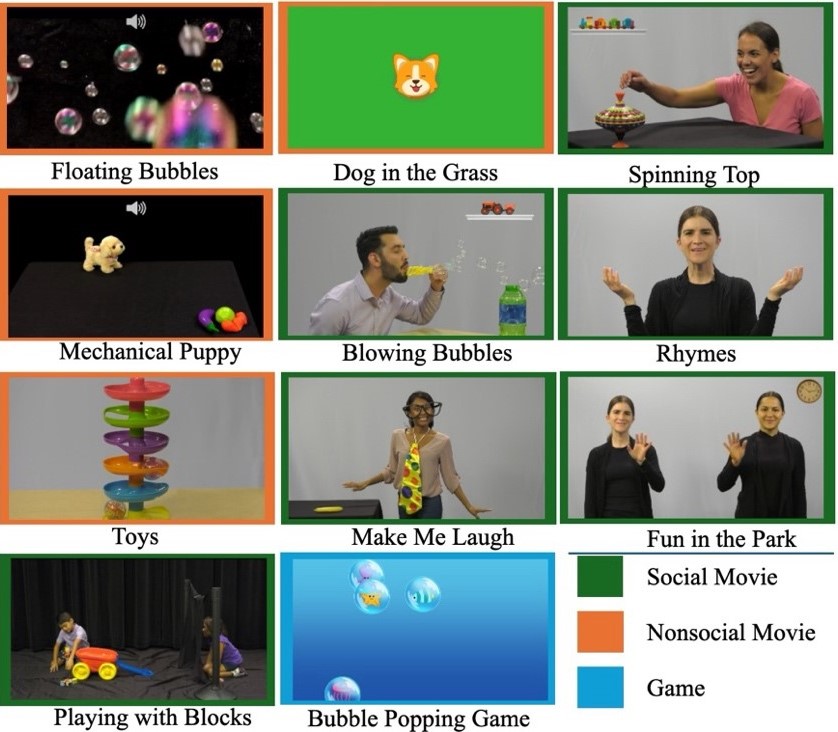
Children came to our clinical research facility at Duke University and watched short videos and completed activities on an iPad while researchers measured behaviors such as attention, eye gaze, facial movement, head movement, and touchscreen interactions.
What Were the Results?
Children with autism, with or without co-occurring ADHD, showed consistent differences from neurotypical children and children with ADHD in many app-based measures. These differences included paying less attention to social information, looking less at people talking in the videos, showing different movement and facial expression patterns, and performing differently on a touchscreen game.
Statistical analyses in our study showed that autism status was linked to 21 of the 23 features measured by the app after correcting for multiple comparisons, while ADHD status was not linked to any features . Overall, the app's measures were much more strongly related to autism than to ADHD.
What do These Results Mean?
The findings suggest that SenseToKnow is capturing behaviors that are closely associated with autism, even when a child also has ADHD. This is important because ADHD commonly occurs alongside autism and can make assessment more challenging. The results support the potential use of digital tools to provide objective information about autism-related behaviors. Distinguishing features of ADHD from autism at this age, even when they co-occur, can help families access the appropriate resources and make decisions about their child’s care. However, the study was not designed to diagnose individual children, and larger studies are needed before the app can be used as a stand-alone diagnostic tool.